Sunday, August 7, 2016

Yellowstone Finale

No Yellowstone collection is complete until the geyser pictures are displayed. To lead off the geysers, of course here is Old Faithful. It erupts now about every 90 minutes, give or take a few minutes, but it can erupt in as short as 35 minutes, or wait as long as 2 hours.  The height ranges from 90 to 180 feet. Steam temperature has been measured at over 350 degrees. It's incredible to stand on the boardwalk by the geyser when it suddenly shoots straight up into the air. Then the water and steam seem to hang in the air before cascading back down like a tremendous waterfall.

On the boardwalks along the geysers, these are bubbling away. The clearer the bubbling water, the hotter the temperature is. You don't want to step or reach into any of it though. Temperature is over 200 degrees.

This is the Castle Geyser. It's on a very old spring, estimates are that it's been building for anywhere from 5,000 to 15,000 years. The castle-looking cone has built up drop by drop to 12 feet tall.

A close up of sunshine highlighting the bubbling and "sloppy splashing" geyser along the boardwalk near Old Faithful.


The steaming Upper Geyser Basin of Yellowstone

A bison and me with a geyser between. The bison is shedding his heavy winter coat.

Roaring Mountain. You can see that this massive mountain is chalk white. It also has some piles of black volcanic stacked stones. Erratic rocks are here and many places in volcanic Yellowstone; these are rocks scattered by eruption - thrown and moved by glacier so long ago. Scientists can identify these because they don't match the underlying geology. With all the fumeral vents on this Roaring Mountain when you stand by it you can still hear it, but these days it's less of a roar and more of a whisper.And with that I whisper my farewell and thank you to Yellowstone, our beautiful first National Park.


Sunday, July 17, 2016

Yellowstone (Part 6) - Soaring Yellowstone


The key to Yellowstone as a national park, was an 1871 exploration under the direction of the government geologist Ferdinand Hayden. Hayden (Hayden Valley) brought along William Jackson, a pioneering photographer, and Thomas Moran, a brilliant landscape artist, to make a visual record of the expedition. Their images provided the first visual proof of Yellowstone’s wonders and caught the attention of the U.S. Congress. The Yellowstone Act of 1872 set a precedent and popularized the idea of preserving sections of the public domain for use as public parks. President Ulysses S. Grant signed the bill creating the nation’s first national park at Yellowstone.  Also the first National Park in the world. Congress went on to designate dozens of other national parks, and the idea spread to other nations around the world.

This is the Golden Gate, Yellowstone style. Having lived many years in the San Francisco Bay Area, I can sincerely say that both Golden Gates infuse you with awe. Here in Yellowstone the highway travels through  a massive, high, solid rock mountain passage.  Here you see how it winds briefly. See how it really does look like a gateway.  We traveled through at sunset, and you can just see the color reflecting with aura off the rocky mountainsides with a golden hue.

The famous, and thrilling, Artist's Point. This is part of the Grand Canyon of Yellowstone. At 24 miles long, it may not be as big as the Grand Canyonn in Arizona, but it is breathtaking. The Lower Falls is 308 feet high and is one of the most photographed features in all of Yellowstone. Thomas Moran on the original expedition and a 19th centruy painter said "its beautiful tints were beyond the reach of human art."
This canyon is the result of erosion, not glaciation. Remember, Yellowstone is the place of volcanic activity. The caldera erupted about 600,000 years ago and covered the area with a series of lava flows. So this erosion proceeded at an accelerated rate. Glaciers then followed the volcanic activity and then those eroded away.

Mineral stains mark the locatons of underground hot springs and steam vents in the canyon walls, turning the rocks yellow, red, white, orange, mauve, pink and so on. Most of the yellows are the result of iron present in the rock, not sulfur. The rocks are essentially rusting, and doing so with great beauty.

This area is filled with incredible hiking trails.

The pinnacle showcases the 440 foot grand waterfalls

What we saw along the Grand Canyon was deer, and a lot of birds including featured osprey as we hiked along the rim. Signs were posted warning of bears.


Gaily singing robin pictured here stretching his wings.

Also delightful finding the smaller falls around Yellowstone in the spring time. High up in these rocky ledges we saw through the telescope rocky Mountain Goats.

Can you just see the white mountain goat lying at rest, surveilling all from his moutain high, rocky bed? I love my camera, but I needed just a little more zoom for this one!
Breathtaking sights around every bend.

Pretty song bird, one of many that serenaded us everywhere.

Cliff swallows nest in colonies. They build nests collecting moouthfuls of mud from edges of puddles and streams. They weatherproof it by linine with feathers and soft grass. So agile in flight, it has no predators to fear in the air. Also adapatable birds as we saw, these nests were part of a colony of about 10 nests that were all on the side of an outhouse.

They're coloring is beautiful, and they truly are darters in flight. They're fast and unpredictable. So fun to see a long line of them peeking out of their nests, seemingly gossiping amongst each other.

Monday, July 11, 2016

Yellowstone (Part 5) Where the Elk and the Antelope Play


Prickly pear cactus in Yellowstone.  It was a surprise to me.  In late June these plants have pretty, yellow flowers.


The elusive coyote. Great excitement to see the coyote walking along the meadow. Alert to every sound, I could see this coyote's ears moving forward and back, and saw him tilting his head to focus on particular sounds. As he got discovered by more people along the meadow, he picked up his loping pace and I was astounded at how quickly he ran, and darted out into the overgrown sage and disappeared from sight.
This elk herd were grazing in front of Devil's Slide, which is just outside the Yellowstone boundaries. Church Universal and Triumphant (CUT) has settled nearby and wished to rename this distinct mountainside Angel's Arc, but somehow the new name never stuck.

Elk in the sage, just watching.

A proud member of the herd, sniffing the air to check for possible danger. If there's something suspicious this elk will alert the rest of the herd.

Elk numbers in Yellowstone are estimated around 15,000. They were heading toward overrunning the Park when the wolves were exterminated. With the return of the wolves has also come a return of many plants to the ecosystem that the elk were eating to extinction. This includes the beautiful aspen trees. Since these trees are recently reintroduced, some of these and other endangered plants are surrounded by exclosure fencing. This is fencing meant to keep the animals out in order to protect the trees, the other growth, and the ecology.

An elk losing his winter coat and enjoying the spring grasses.

A pair of elk who felt we spectators were worth a curious glance, but not a full out alert to the herd.

Here's the famous Roosevelt arch, near Gardiner, Montana.  It was dedicated by President Theodore Roosevelt in April, 1903. One of the entries to the world's first National Park. The legislation declaring this National Park stated it was land set aside for the benefit and enjoyment of the people. I hope now we all realize this Park is the home to the animals - their home. And we are very fortunate to be visitors in their home.

Pronghorn antelope are so beautiful in the wild. Interesting to know, they are near sighted. They also don't like deep snow, their hooves are don't move well in it.  They will come way down in elevation during the winter in order to avoid that snow.

I found that pronghorn antelope herds move very fast and very erratically. Pictures of them truly on the move are mostly a blur. This herd that you see starting to graze had suddenly come running down a hill nearby in our direction. Running incredibly fast, they absolutely glide when they run. There's no bouncing, the entire running motion is completely smooth. The only animal that runs slightly faster is the cheetah. Pronghorn Antelope can run about 60 mph.

Pronghorn Antelope are very wary for their newborns, which are a favorite target of the coyote.  Otherwise, coyote focus on squirrels and other rodents, birds, and insects. Now coyotes are learning how to survive around wolves, often feeding on the remains of wolf kills while staying out of the wolves' way. With the wolves' return, more pronghorn fawns are surviving, helping these beautiful herds grow in number.

Saturday, June 25, 2016

Yellowstone (Part 4) For the Birds and More

Beautiful white pelican in flight. These birds enjoy Yellowstone in the spring and summer.
They feed in the large, slow moving rivers of the Yellowstone plateau. They herd fish into small eddies and stab them with their beaks, catching them in their hanging pouch.  After the water drains out of the pouch, they swallow the fish whole.


A Yellow Headed Blackbird at the edge of Swan Lake. These birdies like marshy areas. They're smaller than their Red Winged Blackbird cousins, and not very common to find.
This Blue Grouse would have been a little perturbed to be disturbed, just above Yellowstone Lake one evening, so we kept our distance.  He was in the midst of a mating dance display. He didn't let us deter him for long, and watching him prance up and down on the ground with his neck puffed out and his tail feathers up and wiggling was excellent entertainment. A deep, almost purring sound came from his throat while in the midst of his dance. Blue Grouse are not nesters, their chicks are up and running quickly after birth, and their mothers provide warmth and protection, and take their young to places where they teach them about good things to eat. Blue Grouse are native to Yellowstone.


Intense color in nature is best defined by the male mountain Bluebird. There's certainly no camouflage here in the spring, they stand out in contrast at Yellowstone. They feed on insects in the grasses. This one is a male. Females show blue only on the rump, tail, and wings. Bluebirds are cavity nesters, sometimes nest in old woodpecker holes.
Ruddy duck in motion. These birds are very active on the lake, with constant and fast movements. They dive to feed on small animals like worms, snails, and insects living in the water.
A male Barrows Goldeneye caught sunbathing on the rock surrounded by the rushing waters.
And here you see he's sharing his rock with a female. These Barrows Goldeneye forage by diving and swimming underwater, rarely spending time in the shallows. These two would mainly be eating insects, dragonflies larvae, and plant life.
A rare sighting of American Avocet swimming in a small lake at Yellowstone. These birds are waders, in the stilt family, and would normally be wading in the shallows.
I learned early in the trip that these aren't Crows, as we have so many of in the Pacific Northwest. These are Ravens, and the two types of birds are different. I noticed right away that Ravens are bigger than even our largest crows. Ravens can be as big as a Red Tailed Hawk. Ravens often travel in pairs, Crows travel in murders (groups). Their tails are also shaped differently, instead of beathers the same length, Ravens' middle tail feathers are longer. Ravens also make a different, lower croaking sound.

This proud Raven was eyeing our field breakfast, and biding his time in the hopes we'd leave something behind for him.
This Marmot was scampering around his rocky den, and cautiously watching his surroundings. In Yellowstone these Yellow Bellied Marmots, as they're called, are mammals. They feed on grasses, seeds, and insects, and in the circle of life, they're prey for coyotes, grizzlies, and golden eagles. They hibernate up to 8 months. The males are very territorial, watch out if one is slowly wagging his tail back and forth.
Ground Squirrel peeking out from the safety under a large rock. These cute rodents are found all over the Park. They eat plants, seeds, buds, roots, nuts, bird eggs, insects and carrion. They look for hiding places from coyotes, weasels, hawks and grizzly bears. They hibernate from October to April.

Ground Squirrel on the alert.
This fine pair of Bald Eagles were seen in the Hayden Valley.  Bald Eagles are one of a dozen raptors in Yellowstone. In 1967 they were on the Endangered Species list. They were removed in 2007. They feed primarily on fish and waterfowl, and nest in large trees near water. They bond for long term pairs.
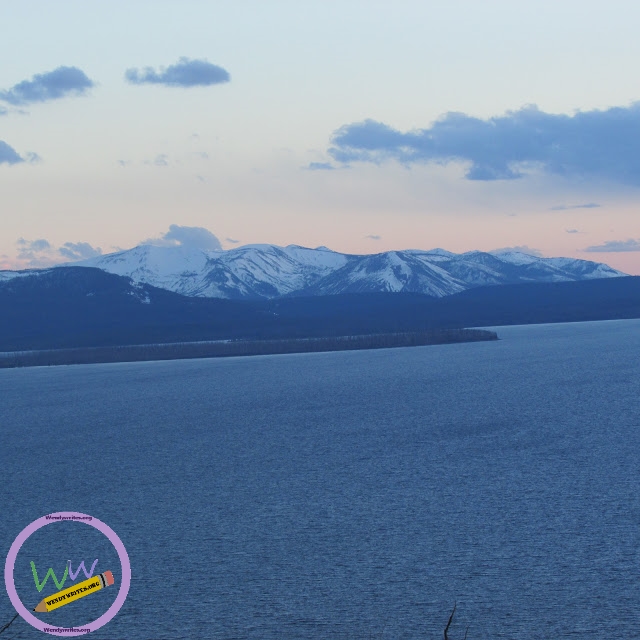
Yellowstone Lake at sunset.
Can you just see him in the overgrowth? He's a Black Wolf, crouching in tall grass by a log. He was watching a small herd of bison. Nearby on top of another log was a Raven who was watching the Black Wolf. I spy with my little eye . . . .

Sunday, June 12, 2016

Bear With Me, Yellowstone (Part 3)

Black bear and her cubs.
These cubs are from this year.  Bear cubs are born in the deep winter months of January and February, while thir mother still hibernated.  In March and April they begin to venture out with their mother as she digs for roots, insects, and looks for squirrels.  They have phenomenal energy and attention spans lasting seconds.
Grizzly bears are usually seen in open areas.  Montana has the largest grizzly bear population in the lower 48 states.  Black bears are most often along the edges of wooded areas in the Lamar and Hayden valleys, or amoung the trees near Mammoth and Tower.
The American black bear can be black, brown, or even white.  All I saw on my trip were black.  Black bears are the only native bear of North America.
Here's another mama black bear and her cub we saw.
The cute bear cub

At one point the adorable cub was prancing and a little dancing, he just couldn't contain his energy.
Black bears are smaller than grizzlies, with adult males weighing between 210 and 315 pounds and females between 135 and 200 pounds.  Black bears have few natural predators.
Black bears eat almost anything including grasses, fruits, tree cambium (thin outside layer), eggs, insects, fish, elk calves, and carrion.  Males and females without cubs are solitary except during the mating season, May to early July.  Both genders usually begin breeding at age four.  Females experience delayed implantation, where the embryo does not immediately implant in the uterus, but is maintained in a state of dormancy.  No development takes place during this delay and so normal gestation is extended.  This reproductive strategy is used by almost 100 different mammals.
While we were in bear country, we were privileged to visit Dan and Cindy Hartman at their gallery, Wildlife Along the Rockies.  Dan has guided for National Geographic as well as BBC films.  His photography, and stories of the wildlife are thrilling.  I enjoy his wildlife photos tremendously.  If you want a glimpse, a real treat, look at Wildlife Along The Rockies
And now I've been photographed by Dan Hartman, you can see here!  I'm standing next to a tree just outside the Gallery.  Just look at those real bear claw marks!
Black bears may live 15 - 30 years.  They can run up to 45 mph.  They can climb trees, but their curved claws and weight makes this difficult.  They can swim, and run uphill and downhill.  And the cubs can dance!